Behind the Photograph
Infinite Spiral, Looking Down
Oriel Staircase, atop the Light Court
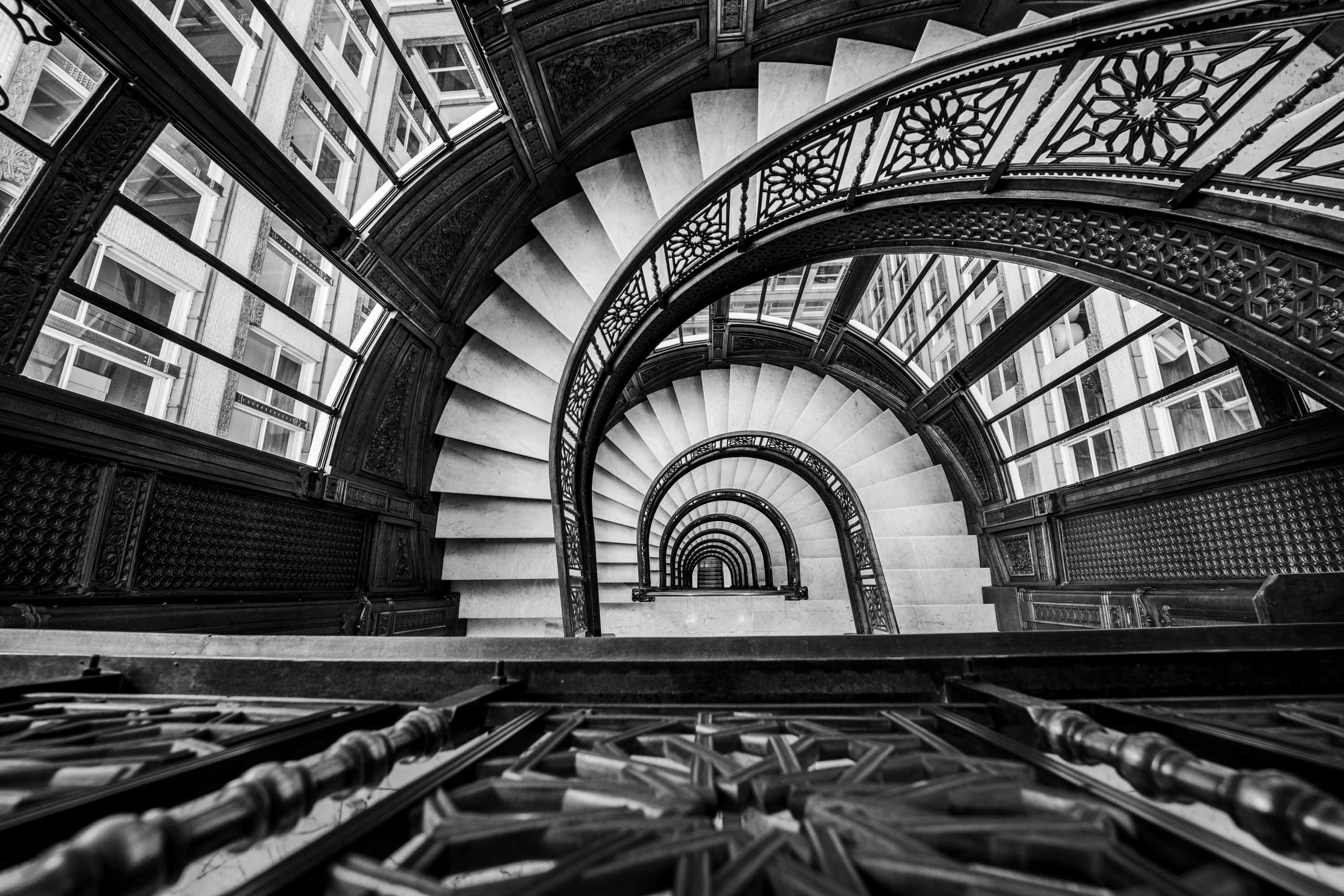
From the twelfth floor of the Rookery Building, the staircase drops away in a precise sequence of curves, steps, railings, and repeating arches. The view feels almost impossible at first. Your eye follows the railing downward, then keeps going.
I was alone when I made this photograph, as I usually was during these visits. The upper floors were quiet. I had time to look, move, study the angles, and wait for the composition to settle.
The photograph was made over the top railing, which stood high enough to support both me and the camera. A super-wide lens held the entire scene in one frame. The nearest rail sat only inches from the lens, soft and dark in the foreground. Instead of getting in the way, it gave the image another layer of depth before the staircase opened beneath it.
I made many versions of this view. I did so every time I returned to the upper floors. The structure offered endless variations, yet the strongest photographs depended on exact alignment. The symmetry of the steps. The continuous turn of the railing. The repeated arches narrowing toward the bottom. Small changes in position altered the entire image.
The staircase had always been part of the building I knew. My Optometry practice occupied space near the Light Court for more than twenty years. Photography made the staircase more interesting and more compelling. It turned a familiar architectural feature into something worth studying again and again.
From above, the design reveals itself through light, texture, and repetition. Pale surfaces catch the daylight. Dark ironwork defines each level. The windows beyond open toward the Light Court, bringing the outside architecture into the frame and preventing the staircase from feeling enclosed.
Black and white felt inevitable. Color would have pulled attention away from the structure. Without it, the photograph rests on form, contrast, balance, and the long winding descent.
What holds me most is the symmetry. The steps turn in measured rhythm. The railing leads downward, level after level, while the windows reveal the Light Court beyond. The photograph invites the eye to follow the staircase all the way down, then return to the top and begin again.