Behind the Photograph
Wright's Light Court
Frank Lloyd Wright Renovation, 1905
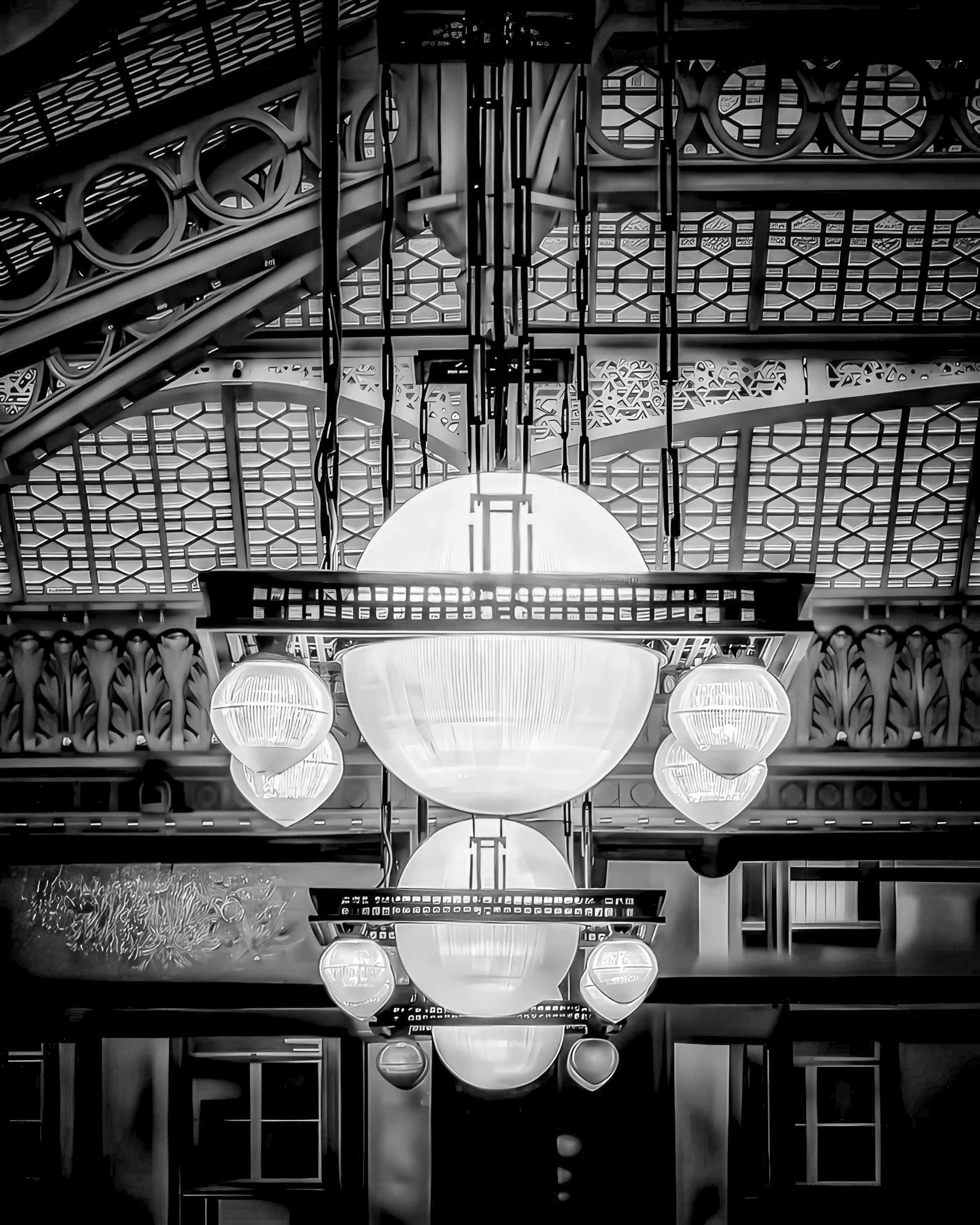
There were quiet stretches in the Rookery when no patients were waiting and the Light Court stood nearly empty. During those moments, I would leave my office with a camera and wander through a building I had already known for years.
On one of those walks, I stopped on the mezzanine.
Across the Light Court, three Frank Lloyd Wright light fixtures hung in a row. I moved until their forms lined up as precisely as possible, placing the largest fixture at the center of the composition. Reflections in a door across the mezzanine repeated portions of the scene, extending the lights deeper into the frame and adding another layer to the surrounding ironwork, glass, and ornament.
The composition was deliberate. I wanted the symmetry to hold everything together.
Wright introduced these fixtures during his 1905 renovation of the Light Court. They are ornate without feeling excessive. Their globes glow softly within the larger architecture rather than competing with it. The light never feels harsh or glaring. It belongs to the room.
That quality matters.
Many large public interiors use lighting that draws attention to itself. Bright fixtures dominate the space and distract from everything around them. Wright's lights do the opposite. They live comfortably inside the Light Court. They illuminate the room while allowing the ironwork, glass ceiling, marble, and decorative details to remain visible.
Photography made me notice this relationship more clearly.
I had worked in the Rookery for years and passed through the Light Court almost every day. Familiarity made the building part of my normal surroundings. Carrying a camera changed the way I looked at it. I began studying how individual elements related to one another. The lights were no longer fixtures hanging above a lobby. They became part of a carefully organized architectural composition.
I first called the photograph Frank's Lights. The title felt personal and direct. These fixtures had become familiar objects in a building where I spent a large part of my professional life.
I have photographed them many times since, from different positions and in different arrangements. Each version reveals something new about how they hang within the court. This photograph remains one of the most carefully aligned. The repeated globes, reflections, dark metalwork, and bright central form create a layered study of symmetry and light.
The image also reflects something larger about the Rookery.
Its beauty does not depend on one staircase, one ceiling, or one celebrated architectural feature. It lives in the details throughout the building. A railing. A carved panel. A pattern in the glass. A fixture suspended quietly above an empty court.
Those details were always there.
The camera taught me to stop and look at them.