Behind the Photograph
The Boardwalk
Lincoln Park · Chicago
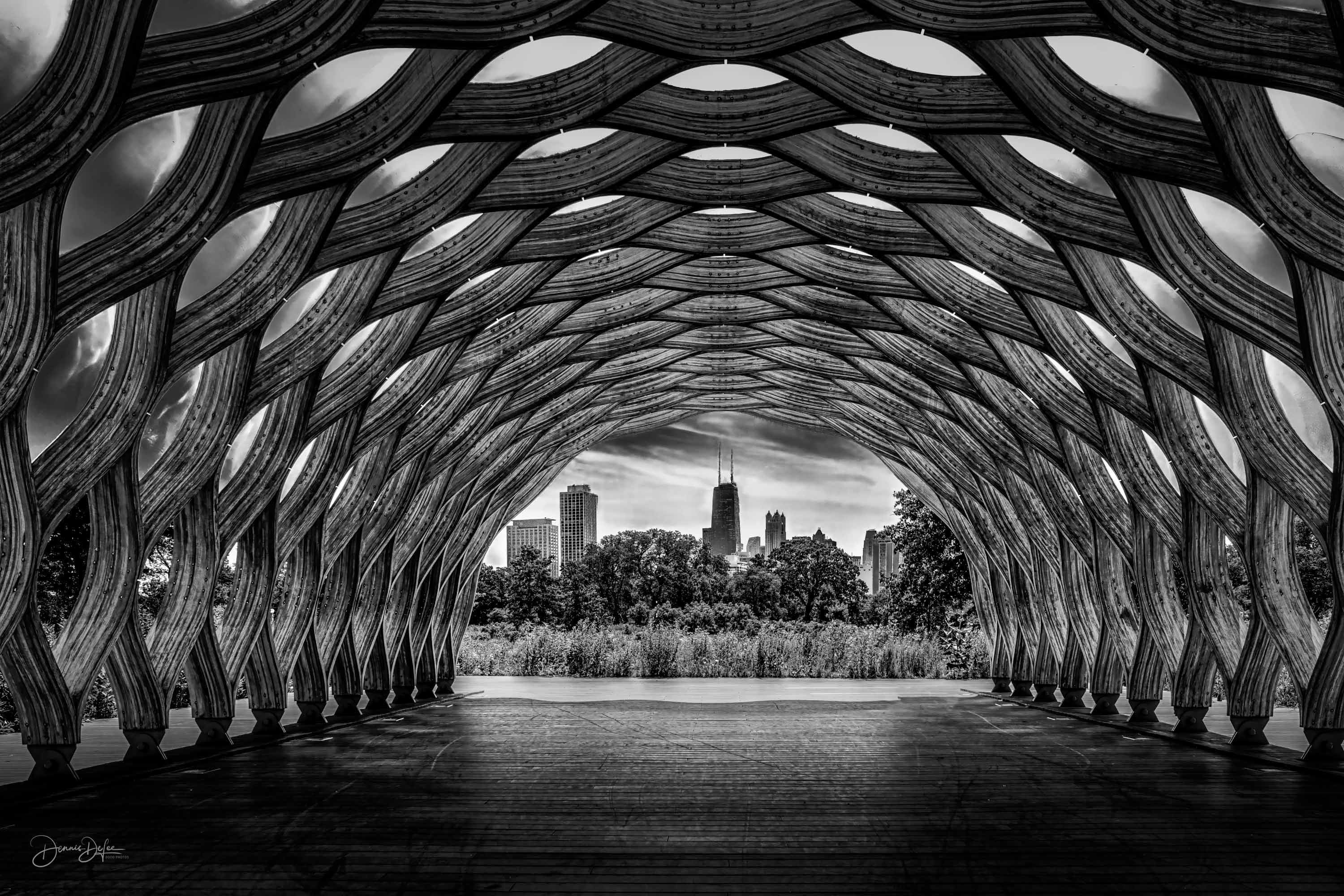
Lincoln Park's Nature Boardwalk is rarely empty.
On a spring afternoon in 2025, I stood a short distance in front of its distinctive wooden pavilion, looking through its sweeping lattice of curved beams toward downtown Chicago. People were everywhere around me. Couples posed for engagement photographs. Wedding parties moved through the area. Visitors crossed the bridge over South Pond. The pavilion itself sometimes hosts weddings, meetings, yoga, and educational programs.
For the photograph I wanted, none of them could be inside.
So I waited.
Patience is part of photographing this place. Sometimes I have waited half an hour for the scene to clear. This time it took only five or ten minutes. Eventually the last person walked out, and for a brief interval the pavilion belonged entirely to its architecture.
Empty was empty. That was what I needed.
I positioned myself carefully so the curving wooden members enclosed the scene symmetrically, one arch repeating inside another as they receded toward the opening. Beyond them, Chicago appeared in the distance. I adjusted my position until the John Hancock Center, the familiar vertical marker of this part of the skyline, sat close to the center.
The pavilion became a frame within the photograph.
Its wooden ribs pull the eye inward from both sides and overhead, narrowing gradually toward the city. The darker interior naturally gives way to the brighter landscape beyond. Trees and prairie grasses fill the middle distance before the skyline rises above them. The architecture provides the structure. Chicago provides the destination.
The pavilion is officially the Peoples Gas Education Pavilion, part of Lincoln Park Zoo's Nature Boardwalk. The entire landscape around it is considerably newer than it appears. South Pond dates to 1908, when it reflected an earlier idea of an ornamental urban park. By the beginning of the twenty-first century, the pond had become a hard-edged landscape surrounded largely by turf grass and non-native vegetation. Lincoln Park Zoo began reimagining the site in 2009, transforming it into a functioning prairie, wetland, and savanna habitat. The renewed Nature Boardwalk opened in June 2010.
Studio Gang designed the 14-acre project, including the pavilion. The restoration addressed water quality, wildlife habitat, accessibility, stormwater management, and education while keeping the city visibly present. Rather than separating nature from Chicago, the design deliberately brings the two together. The zoo itself describes the pavilion as a structure that frames the Chicago skyline.
That makes this particular view especially satisfying to me. The photograph does exactly what the architecture was designed to do.
I have lived within walking distance of Lincoln Park Zoo for years. My family has been there many times with our children and grandchildren, especially during the summer. The Nature Boardwalk was never the part of the zoo we visited most often, but I had seen this pavilion enough times to know I wanted to photograph it seriously.
I had photographed it before, and I returned specifically for this view as well as photographs from the bridge over South Pond. The pavilion has such an unusual form that I have never seen another structure quite like it. Its curves, repetition, and symmetry offer almost endless possibilities with a camera.
For this image, those elements all came together.
I also have a color version that I like very much, but black and white changes the emphasis. Without color competing for attention, the tones in the wood become more pronounced. Its texture becomes clearer. The repeating structure becomes the subject rather than one element among many. The shadows inside the pavilion and the bright city beyond separate more strongly.
That is one reason I return so often to black and white when photographing Chicago. The form matters to me. So do texture, light, and structure. Here, all four are present in abundance.
Yet what I like most is still the simplest part of the photograph.
Symmetry. Form. And a view of Chicago fit perfectly inside a frame that was already there.