Behind the Photograph
The Grand Staircase
Light Court, Frank Lloyd Wright Renovation, 1905
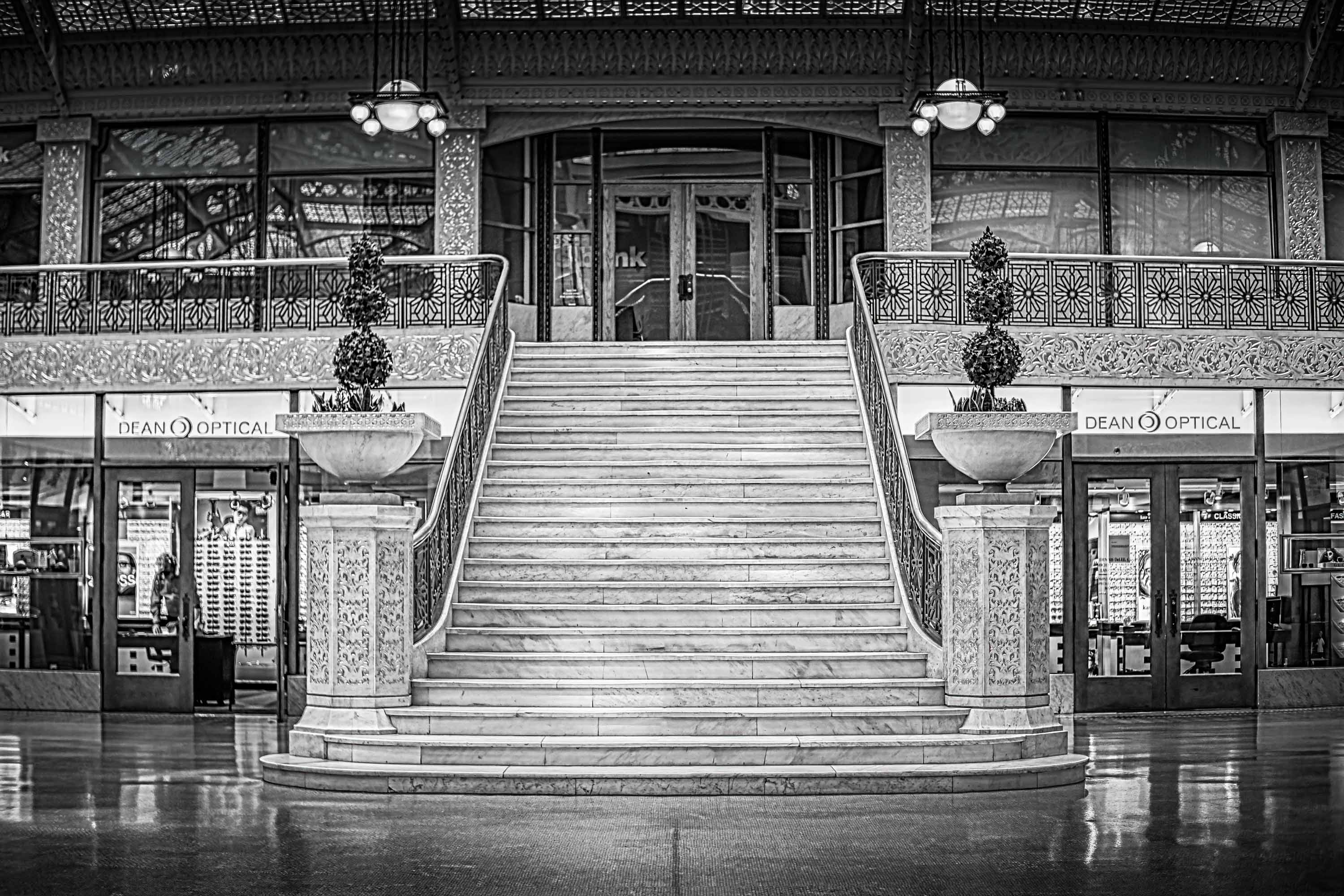
The grand staircase of the Rookery Building rises from the Light Court with a sense of order and ceremony. Seen straight on, the composition feels almost perfectly balanced. Twin planters stand at the base. Matching lights frame the stairway. Delicate ironwork stretches across the balustrade like lace. Every line guides the eye toward the center.
For more than twenty years, this staircase stood directly outside my Optometry practice.
I did not first know it as a photographic subject. I knew it as part of daily life. I walked past it on the way into the office. I descended it at the end of the day. Patients crossed the Light Court on their way to appointments. Vendors stopped to look around. Visitors often paused, surprised by the beauty of the building they had entered.
The Light Court changed the experience of arriving.
Patients who had driven through traffic, searched for parking, and hurried into the building found themselves in a space filled with glass, ironwork, light, and architectural detail. Some sat quietly before their appointments and looked across the court. Others commented on how fortunate we were to work there.
Years ago, I attended a conference where a speaker discussed the value of giving patients a place to “cool down” after the effort of reaching an appointment. I remember thinking that nobody had a better place to do that than we did.
The Rookery could be busy, but the Light Court rarely felt crowded. At times, architecture students sat nearby drawing or studying the building. They were usually quiet, absorbed in the details around them. The openness of the space softened the sounds of movement and conversation. Even during a working day, the staircase often seemed still.
I made this photograph in 2020 with my Sony A6500, my first serious digital camera.
I photographed the staircase from several positions. I tried the corner of the Light Court. I tried views from the side. Each angle revealed something different, but the straight-on composition felt right. It allowed the symmetry to hold the image together and gave the staircase the formal presence it had always carried for me.
I converted the photograph to black and white because color was not the central subject. The structure was. Without color, the curves of the ironwork, the pale stone, the repeating lights, and the measured rise of the stairs become more distinct. The image becomes quieter, closer to the way the space remains in my memory.
Many people visit the Rookery because of its history and architecture. I experienced it through repetition. It was where I worked, where my patients arrived, and where ordinary days unfolded inside an extraordinary building.
Every time I walked down this staircase, I felt as though I were walking into history.
The photograph preserves more than the appearance of the Grand Staircase. It holds the experience of passing through that space year after year, long before I stopped to place a camera in front of it.