Behind the Photograph
The Oriel Staircase
Burnham & Root, 1888 — Light Court Renovation, Frank Lloyd Wright, 1905
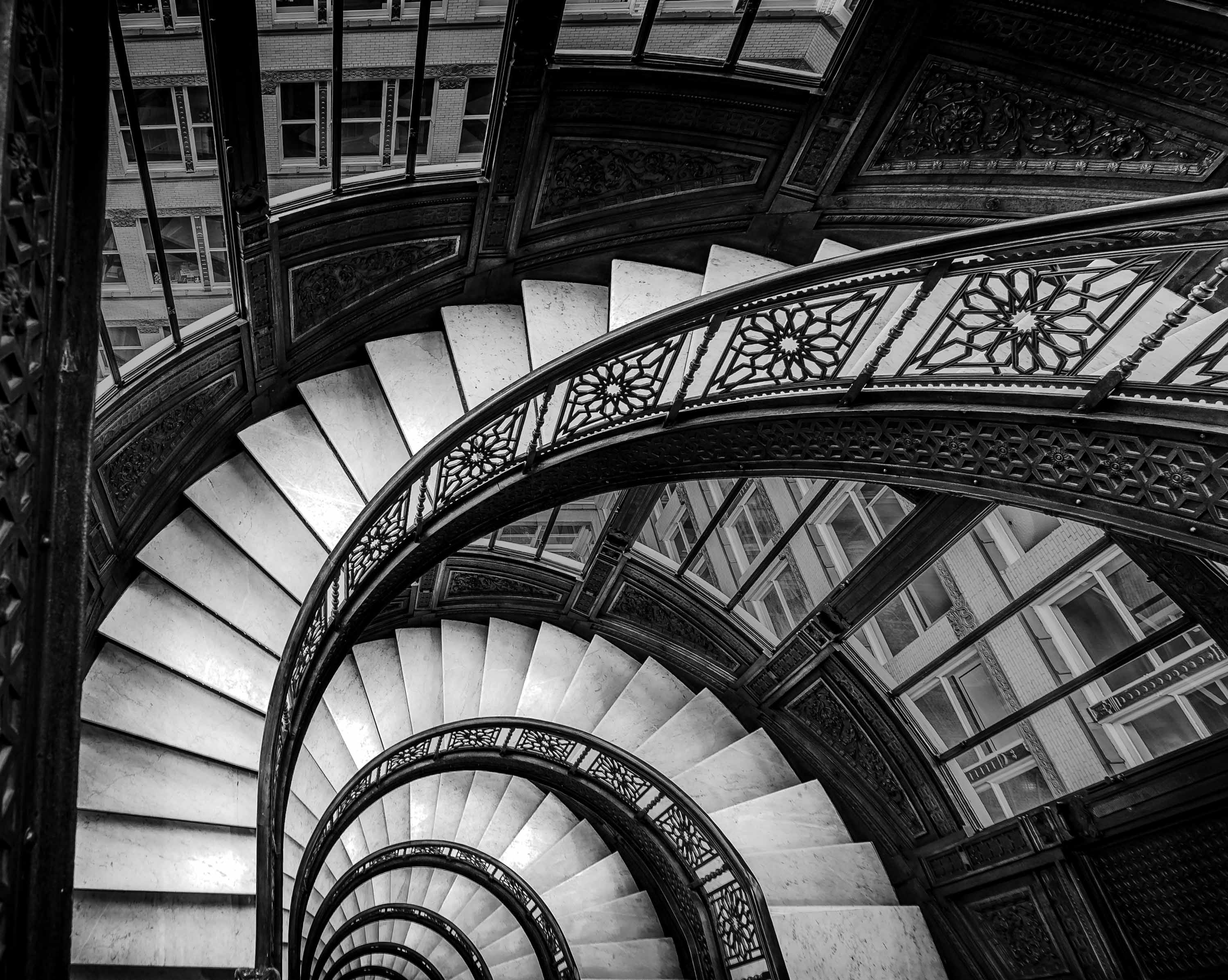
The Oriel Staircase at the Rookery is easy to miss.
Most people know the building through its Light Court, its grand staircase, and Frank Lloyd Wright's luminous interior. The Oriel Staircase sits farther from public view. To see it from above, you need to reach the 12th floor, at the very top of the spiral.
For more than twenty years, my Optometry practice was located just off the Rookery's Light Court. As a longtime tenant who knew the building and its staff well, I was allowed to visit the top of the Oriel Staircase whenever I wanted to photograph it.
I never used the staircase to move through the building. I had no reason to. I went there to photograph it.
A visit usually lasted about ten minutes. I would reach the upper landing, study the patterns in the walls, railings, and stairways, work through several compositions, and enjoy the solitude. No one worked on that floor. I rarely saw anyone else near the top of the staircase.
The building seemed to fall quiet there.
The lobby sat far below. Occasionally, I might hear the faint ding of an elevator from another floor. Otherwise, there was little sound. For those few minutes, I had the architecture to myself.
Many photographs of spiral staircases look straight down through the center. I made those photographs too. The direct view emphasizes symmetry and depth. It creates a smooth, almost hypnotic descent toward the bottom.
This composition felt different.
I stood at the top and looked down from a slight angle. The view became less settled. The curves no longer descended with perfect visual ease. The railing crossed the frame more forcefully, and the steps seemed to turn through several competing directions.
The angle introduced a little tension.
Yet the architecture remained exact. Each stair aligned with the stair beneath it. Every railing followed the same repeating path. Even from an off-kilter viewpoint, the structure held together with extraordinary precision.
That balance drew me to this frame.
The staircase is ornate, but its decoration never feels random. Dark carved panels follow the walls. Ironwork forms repeating geometric patterns along the railing. Pale Italian marble steps sweep around the open center and catch the light entering through the windows.
The marble carries the physical record of the building's age. More than a century of footsteps has softened parts of the treads. The wear is visible, but the staircase remains remarkably preserved. It does not feel fragile. It feels used, cared for, and still completely itself.
The Light Court made this interior possible. The Rookery was designed to bring daylight into the center of the building, allowing tenants to receive light from windows facing both the streets and the interior court. At the top of the staircase, the windows open toward that inner space, and the light moves across the marble, wood, and iron from several directions.
I chose black and white because color distracted from what interested me most.
Without color, the staircase becomes a study of light, texture, repetition, and structure. The marble steps separate from the dark railings. The carved surfaces become more pronounced. The windows hold a quieter tone while the strongest light moves across the stairs.
I sometimes call this photograph The Oriel Spiral, a title that separates it from my other views of the staircase. From this angle, the staircase feels more distinctly spiral. Its movement is less like a single drop and more like a series of curves turning through the building.
After being away from the Rookery for a year and a half, I returned recently and was welcomed back upstairs to photograph the staircase again. My daily life in the building had ended, but the upper landing still held the same silence.
The photograph remains tied to the years I worked there, but it also belongs to those brief visits when I stepped away from everything else. I was not there to reach another floor. I was not passing through.
I was simply standing at the top of the staircase, camera secured by its strap, looking through the windows into the Light Court and spending a few quiet minutes inside the history of the building.