Behind the Photograph
Chicago Board of Trade
In Front of the Rookery · Chicago
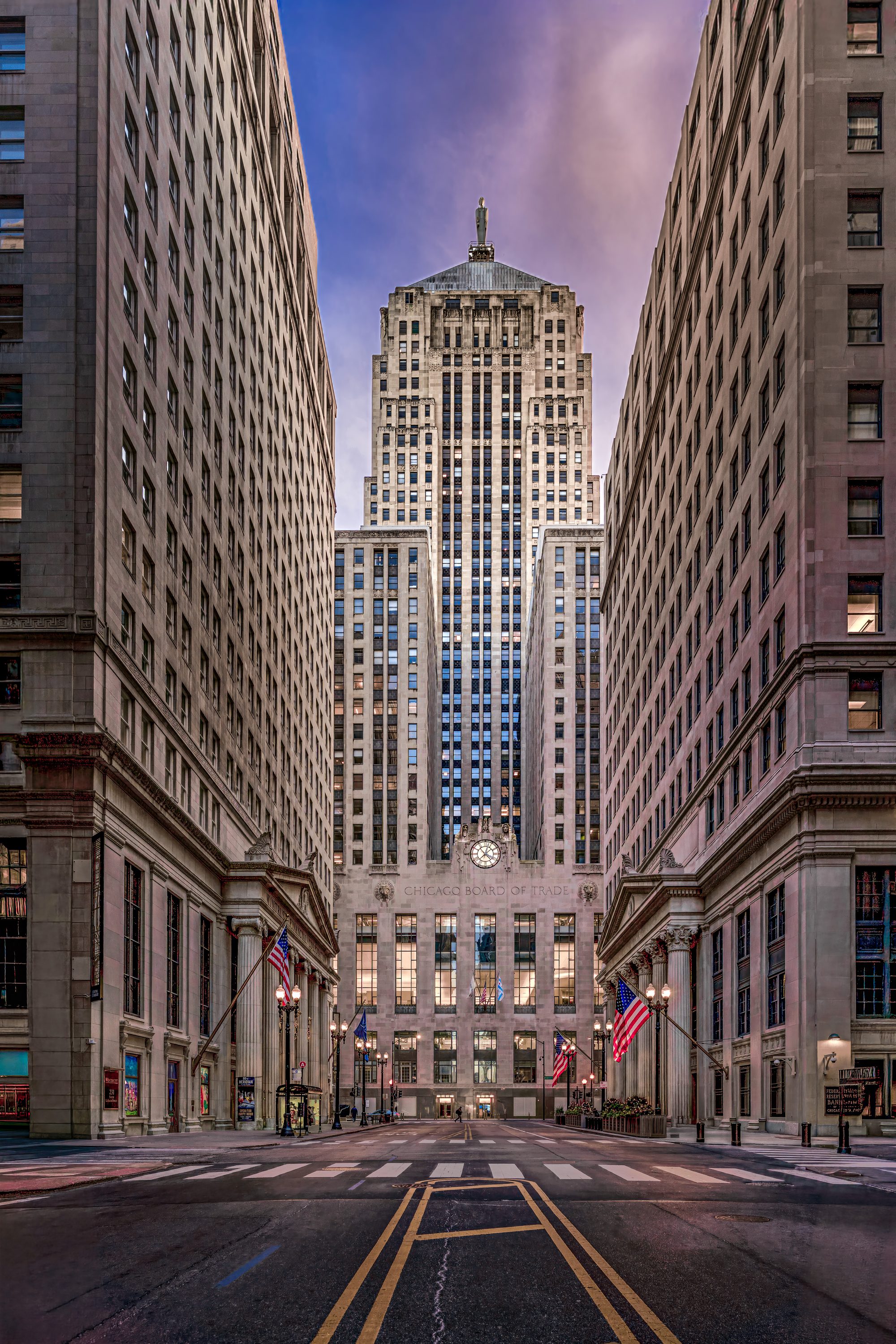
LaSalle Street ends at the Chicago Board of Trade the way a sentence ends at a period — deliberately, and with weight. I had photographed this corridor once before, from the bridge to the north where the street first opens onto the canyon. This time I wanted to stand closer, in the middle of LaSalle itself, directly in front of the Rookery, where the symmetry is tightest and the building fills the frame completely.
That block also happens to be where I spent twenty years of my working life. The Rookery stands on this stretch of LaSalle, between Adams and Quincy, and for two decades I walked this sidewalk every day on my way into the office — always from the curb, never from the middle of the street, the way I stood to make this photograph. I had looked at the Board of Trade thousands of times without a camera in hand. Photographing it now felt less like discovering a new subject and more like finally writing down something I had been thinking for years.
I made this photograph in November, in the last light before evening rush hour, waiting for blue hour — the short window after sunset when the sky holds onto color the streetlights haven't yet washed out. LaSalle Street is rarely empty. Getting it this quiet took patience: I watched for a break in traffic, stepped into the middle of the street, and made the exposure before the next wave of cars came through.
Ceres stands at the top of the tower, John Storrs' aluminum figure watching over the trading floor below her. I wrote more about her in the story behind an earlier photograph of this same street. What drew me to this frame was everything around her — the two buildings that flank the Board of Trade and complete the symmetry: the colonnaded limestone facade of Wintrust, formerly Bank of America, on the left, and the Federal Reserve Bank of Chicago's fortress-like presence on the right. Together with the Board of Trade, they were the three institutions that gave LaSalle Street its old nickname — Chicago's own Wall Street.
I chose to keep this one in color. The black-and-white version I made from the bridge is about geometry and texture — stone, steel, and shadow. This one is about the sky. The violet and rose tones only last a few minutes at this time of year, and they are the reason the photograph exists. Strip out the color and you lose the entire point of standing on that corner at that hour.
Not a car breaks the frame. Not a pedestrian crosses the street. Only the yellow lane markings lead the eye forward, past the flags and the lampposts, to the clock and the glowing windows at the base of the tower. It is the kind of quiet this street almost never offers during the day — the kind I recognized instantly, because I used to walk it every morning before the crowds arrived and every evening after they had gone.
This is the photograph I think of when people ask what twenty years inside the Rookery taught me about the neighborhood around it. Not just the building I worked in, but the street it sits on, the buildings that face it, and the particular kind of Chicago light that makes all three worth photographing again and again.