Behind the Photograph
The Water Tower
Michigan Avenue · Chicago
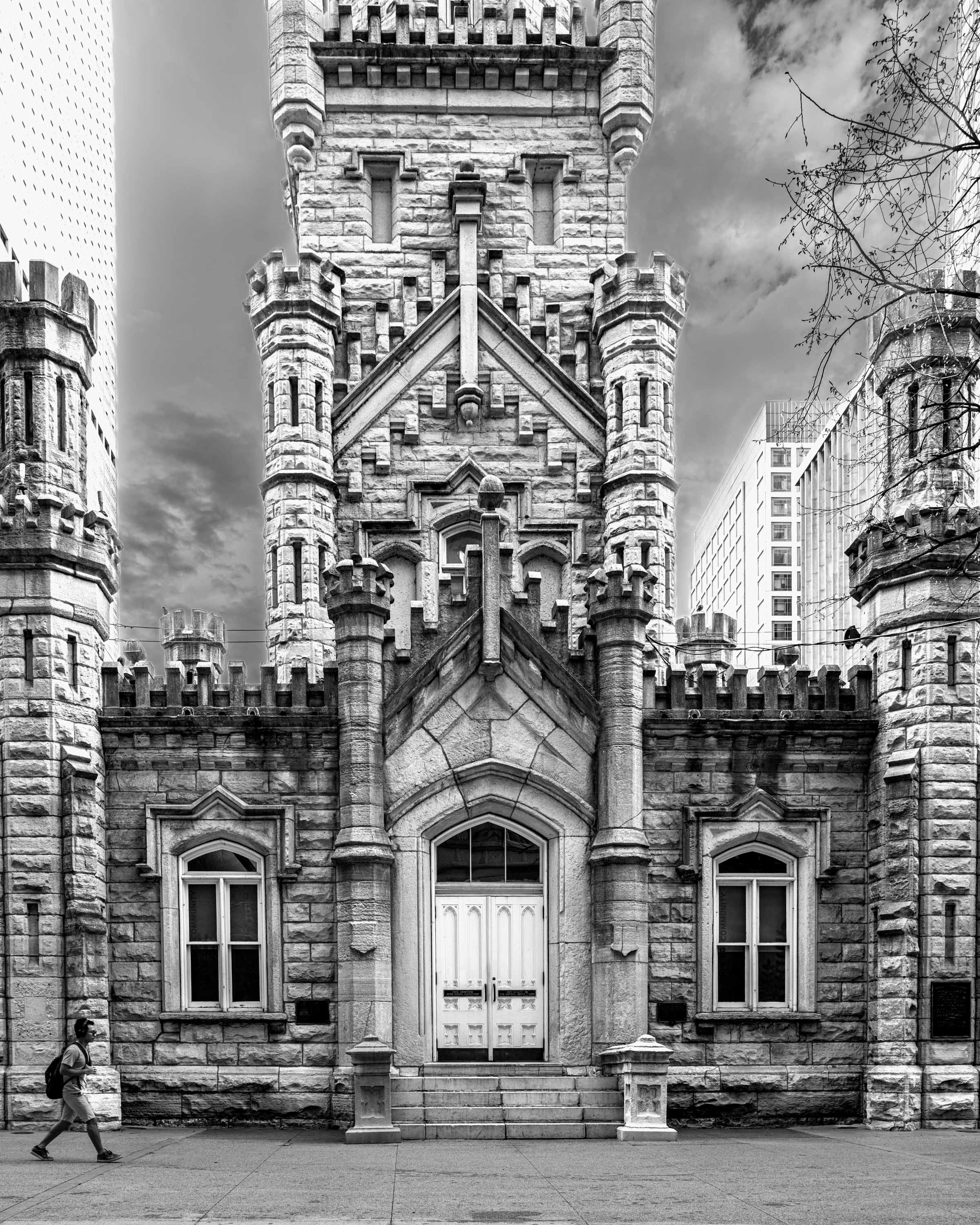
I had walked out the door expecting to try a new camera. Instead, one of the oldest buildings in Chicago was waiting for me.
A new Leica Store opened on North Michigan Avenue, directly across a small park from the Chicago Water Tower. That spring morning I went to look at a camera and came out with one. The Water Tower was perhaps thirty feet away, almost perfectly centered in front of the shop.
So, this was my first photograph.
I did not need to search for an angle. From where I stood, the tower filled nearly the entire frame. I was drawn immediately to the limestone. The texture, the variations in tone, the arches, battlements, windows, and carved details all became more pronounced in black and white.
That is naturally how I see much of Chicago. I am a black-and-white photographer, particularly when I am photographing the city. Removing color brings me back to shape, texture, light, and tone. With the Water Tower, those elements are the building.
The composition looked ready, but Michigan Avenue rarely is. I waited for some of the crowd to move away, then watched one pedestrian approaching the tower. When he reached the spot I wanted, I took the photograph. He is a small presence in the frame, but an important one. Against all that stone, one person gives you an immediate sense of the tower's scale.
Above it, the spring sky was filled with the kind of clouds I am always happy to find when I am photographing. They give the pale limestone a darker backdrop and help separate all those Gothic details from the sky.
The Water Tower was completed in 1869, designed by William W. Boyington as part of a new system created to bring cleaner Lake Michigan water to a rapidly growing Chicago. Its ornate Gothic Revival exterior surrounded something far more utilitarian: a massive standpipe used to help regulate pressure in the city's water system. The nearby pumping station was part of the same project.
Two years later came the Great Chicago Fire.
The fire tore through the city in October 1871, destroying much of downtown and leaving roughly 100,000 homeless people. The Water Tower and pumping station remained standing in the burned district. They were not the only structures in Chicago to survive, as the familiar story is sometimes told, but the Water Tower became the most recognizable survivor. Over time, it became something larger than a piece of municipal infrastructure. It became a symbol of the city that was rebuilt around it.
I feel as though I have always known that story. I learned about the Great Chicago Fire in school and read about it growing up in Chicago. The Water Tower has always seemed to belong to the top of North Michigan Avenue.
It has also been part of my own geography for decades.
For fifteen years, I practiced Optometry across Michigan Avenue at Water Tower Place before eventually buying my practice in the Loop. I walked past the tower countless times. My family and I have shopped along North Michigan Avenue for years, passing it again and again. I have photographed it many times too.
But never quite like this.
What I noticed most in this photograph today is still what caught me when I stepped outside that morning: the texture and tones of the old limestone. Modern Chicago surrounds the Water Tower now, but the building itself remains unmistakable.
More than 150 years after the fire, it is still standing in the middle of Michigan Avenue.
And on this particular spring morning, it happened to be standing directly in front of me.