Behind the Photograph
The Great Hall
Union Station · Completed 1925
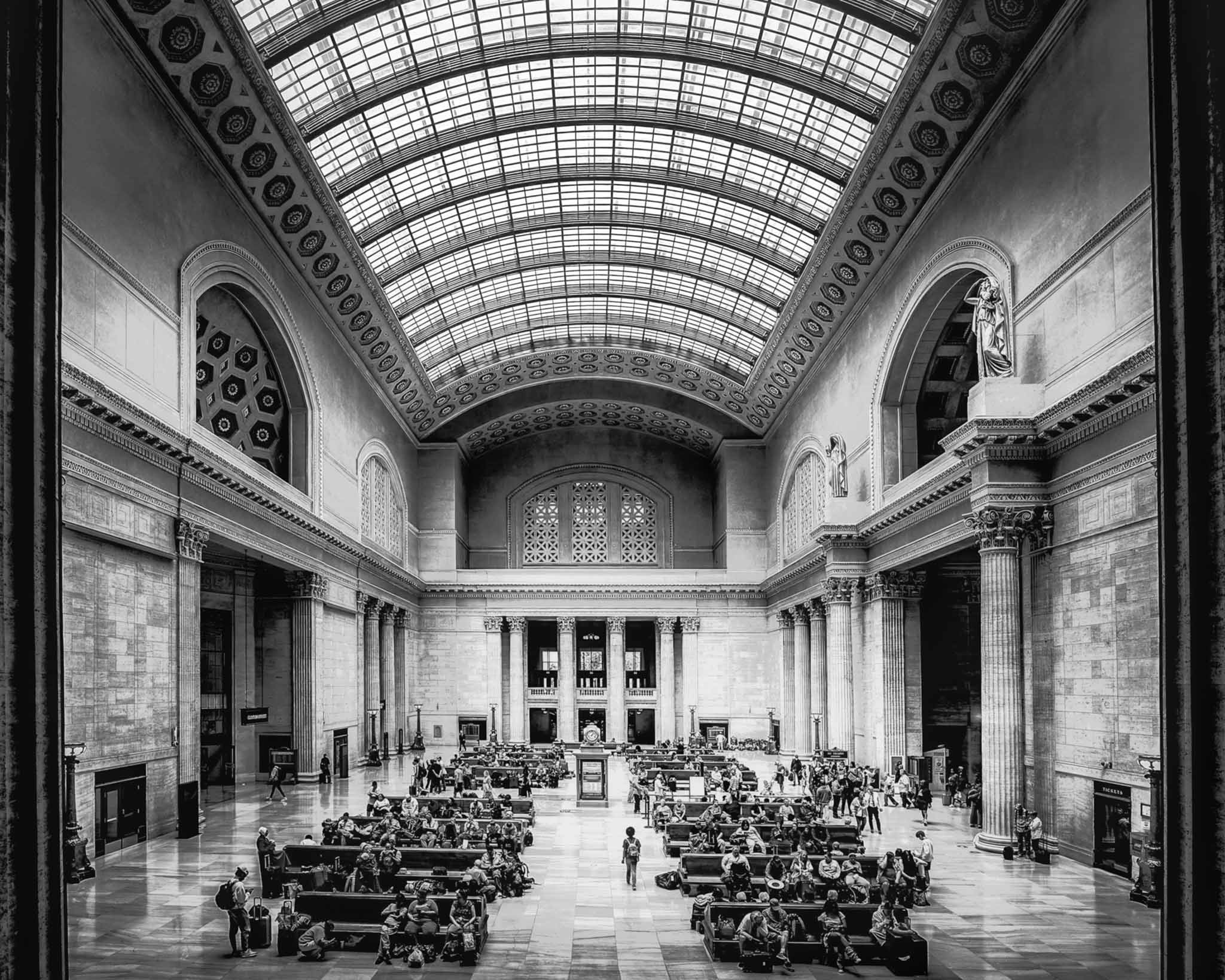
From the balcony, the first impression is order.
The Great Hall opens below in near-perfect symmetry. Massive columns rise along both sides. Arched openings repeat across the walls. At the center, a clear aisle runs through rows of wooden benches toward the far end of the room. Above everything, daylight pours through the long, barrel-vaulted glass ceiling.
Then you notice the people.
Hundreds of passengers fill the benches and gather along the edges of the hall. Some sit quietly beside their luggage. Others stand in small groups or move through the crowd. Conversations overlap beneath the ceiling. There is patience, impatience, and the steady background buzz of people watching the clock.
Everyone is waiting for something different.
A train. A departure time. A family member coming home. The next stage of a longer journey.
I went to Union Station during the summer of 2025 specifically to photograph the building. I knew it as one of Chicago's great old structures, an enormous place built during the era when railroad stations carried the importance now given to major airports. I had traveled through Union Station only a few times, but every train trip I had taken from Chicago began here.
The present station opened in 1925 after ten years of construction. Four railroads joined together to build it in response to the growing demand for passenger travel through Chicago. The building reflected Chicago's position as a national railroad hub, connecting routes arriving from the East with lines continuing across the Midwest and toward the West.
Its architects gave those travelers far more than a practical waiting room.
The Great Hall's barrel-vaulted skylight stretches 219 feet and rises 115 feet above the floor. Its scale belonged to an age when public buildings were expected to express permanence and civic importance.
From the balcony, the ceiling becomes the source of the entire photograph. Soft daylight falls across the stone walls, catches the columns, and reaches deep into the room below. The light separates the architecture into layers while keeping the people visible within it. They do not compete with the building. They reveal its size.
I made several photographs from the balcony, supporting the camera on either the railing or a monopod. I worked quickly. I also wanted to photograph the rest of the Great Hall and the exterior colonnade before leaving.
For this frame, I waited until the central aisle opened.
Most of the passengers remained gathered around the benches. One small boy stood alone in the aisle, separated from the larger clusters around him. His presence gives the eye somewhere to settle. He also provides a measure for the building. Without him, the hall would still appear grand. With him, its scale becomes unmistakable.
He is surrounded by hundreds of people, yet for a moment he appears entirely on his own.
Black and white felt natural for this photograph. Union Station belongs to an earlier architectural age, and removing color allows the scene to move beyond the summer of 2025. Clothing styles have changed. Luggage has changed. The trains themselves have changed. The essential experience beneath the skylight remains familiar.
It has likely looked much like this for generations. Daylight falling from above. Benches filled with passengers. Conversations rising into the vaulted room. People waiting for their train, or for someone they love to return.
The station exists to keep people moving across the country. The Great Hall gives them a place to stop.
For a few minutes, hundreds of separate journeys share the same room.
Then the clock advances, a train is called, and the crowd begins to change.
The photograph remains.